Google dot org blog - News from Googles Philanthropic Arm

Updated imagery of flooding near Council Bluffs, Iowa


Since June of 2011, Council Bluffs, Iowa and the surrounding area has experienced record flooding along the Missouri River. Google has a data center in Council Bluffs, along with many employees that live in the city and surrounding region.

Along with our neighbors, we watched with concern as the Missouri River rose to a level not seen in decades. We are grateful for the extraordinary work of the City of Council Bluffs, Pottawattamie County, the Army Corps of Engineers and others who kept the city and much of the surrounding region safe. Our hearts also go out to those who have lost homes and businesses to the rising waters.

We recently worked with our satellite provider, GeoEye, to acquire updated imagery of some of the affected area. This imagery is now available as a KML file and will be live in the Historical Imagery section of Google Earth in the coming days. We hope that it will be of use to emergency responders and the general public.

Eppley Airfield and region to the north (before and after)

Area between Council Bluffs/Omaha and Blair, Nebraska (before and after)

You can access all the new imagery by downloading the KML file and opening in Google Earth.

Permalink | Links to this post |

Google Supports The Citizen Media Global Innovation Competition

(Cross-posted from the Google Nonprofits Blog)

Media is an integral part of how people understand, access, and share information about the world around them. Communication channels including newspapers, television, blogs, and online videos have tremendous potential to empower and influence individuals across the globe. Yet, millions of people still face barriers that limit them from tapping into these resources. They are marginalized by political and economic situations and other limitations that deprive them of the full citizenship made possible by access to news, information, and connections to people outside of their immediate environments. That’s why we’re working with Ashoka to find and support the best, most innovative ideas out there that will help people around the world unlock the power of media and participate more fully in society.

Today marks the beginning of a new initiative run by Ashoka’s Changemakers, with support from Google, to source innovations that will boost media access and participation globally: Citizen Media: A Global Innovation Competition. What do we mean by this? Well, we’re waiting for you to tell us, but here are some initial ideas for what strong entries might hope to achieve:
  • Give voice to underserved, vulnerable populations, introducing them to media creation and distribution, and showcasing their messages
  • Equip journalists and publishers with tools or channels to report important news that otherwise gets missed
  • Advance free speech and privacy protections
  • Address the financial sustainability of quality news
  • Help people better navigate information and ascertain content reliability and authenticity
Nominate your idea or suggest another innovation starting today! Submissions are due on September 14th, and finalists will be selected by a panel of expert judges including Michael Maness, VP of Journalism and Media Innovation at the Knight Foundation, Esther Wojcicki, Vice Chair for Creative Commons, and Jared Cohen, Director of Google Ideas. Then, Ashoka will invite the public to vote on four winners who will receive cash prizes of US $5,000. Top qualifying entrants will also be considered for an Ashoka Fellowship — complete with a living stipend, international recognition, and access to a network of systems-changing social entrepreneurs. To encourage a breadth of global applications, the competition is being launched in nine languages: Arabic, Mandarin, English, French, Indonesian, Japanese, Portuguese, Spanish, and Thai.

We’re excited to see the ideas submitted to this competition and to help social entrepreneurs advance their innovations.

This competition is run by Ashoka with sponsorship from Google. Submit your idea on: http://www.changemakers.com/citizenmedia

Permalink | Links to this post |

South Sudanese sing and map their way to independence

(Cross-posted from the Google Latlong Blog)

On July 9, South Sudan will officially be independent, becoming Africa’s 54th state.

In anticipation of this significant development, the World Bank, UNOSAT, RCMRD, Satellite Sentinel Project and Google organized a South Sudan Community Mapping event in Nairobi on June 30. This was the second in a series of mapping events intended to encourage local people to create accurate and detailed maps of South Sudan, to help them navigate their path to independence. There were over 100 attendees in the room, mostly Sudanese -- university students, humanitarian workers, journalists, developers, donors, citizens -- coming from Nairobi and its surroundings, but also as far as Juba, the capital of South Sudan.

The lives of the South Sudanese are anchored to their history and land. The event started with the sharing of prayers, stories and songs, allowing each of us to visualize the rivers, sheep, roads, and people. Drawn from these songs, the mapping of South Sudan with Google Map Maker began. I was excited to see schools, roads, rivers, historical monuments, and cemeteries being mapped over cities such as Aweil, Boma, Bor, Malakal, Rumbek, Tonga, Torit, and more.
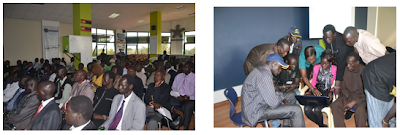
Community Mapping Event in Nairobi on June 30, 2011

Many were interested in health resource mapping which can dramatically impact the lives of their new countrymen. Every year in South Sudan about one in every seven children dies before the age of five; the maternity mortality rate is one of the highest in the world, and only 30% of the population has access to health care. For Charles Mona, Director GIS, Remote Sensing & Cartography of the South Sudan Government, quality health resource maps would be great tools for improved health care planning, resource allocation, advocacy, and also increased access to health services for the local population. This is only one example of how accurate maps can help various organizations provide better services to the the South Sudanese.

Happy independence day to the South Sudanese! Together, let’s continue mapping, and stay connected via our Sudan-specific email discussions. The next Community Mapping event will be in Juba, so stay tuned for more details.

Permalink | Links to this post |